Description:
Plank Road Contributes to Town Growth
In 1902, downtown property owners paid 25 cents a foot towards the construction of a 10-foot-wide plank sidewalk for pedestrians from the corner of Grant Street and Front Street around Knob Hill to Newtown, a total length of less than a quarter of a mile. Today, the path no longer exists, but if it did it would run roughly on the outside of the tunnel. A few months after the sidewalk was built, Ketchikan's first horse and wagon was hired to carry goods by Mike Connell and Fred Billiard's draying business. As Ketchikan grew so did the amount of plank sidewalks and "roads."
A photograph of an early automobile on Main Street, taken around 1911, is this month's featured artifact. Governor Wilfred B. Hoggatt is shown driving a 1911 International Harvester Co (IHC) car. Among the passengers are businessman and inventor of the floating fish trap, J.R. Heckman, and his wife, Marie, and George Rounsefell of Fidalgo Island Packing Company. Standing next to the car is Dr. John Myers in front of his practice.
Newt Casperson, owner of Ketchikan Carbonation Works, brought a passenger automobile to town in 1913. The only cleared path suitable for the car was from one cannery in Newtown to another in "Indian Town," or the area south of Ketchikan Creek. Using the original unpaved 10-foot-wide plank sidewalk turned road, the car ran day and night as a taxi. By fall of 1913, Newtown was connected by a viable road to the west end of town. Within a few years, a dirt road extended south to Herring Cove and north to Ward Cove, opening up numerous commercial opportunities and establishing a need for the Fire Department's Pumper Truck #1. Front Street became the first paved road in Alaska in 1923.
Object ID #: THS 62.4.1.41
Click to Enlarge
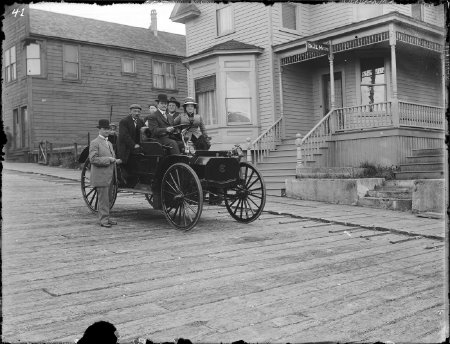 Early automobile in Ketchikan, circa 1911. Photograph by Forest J. Hunt.
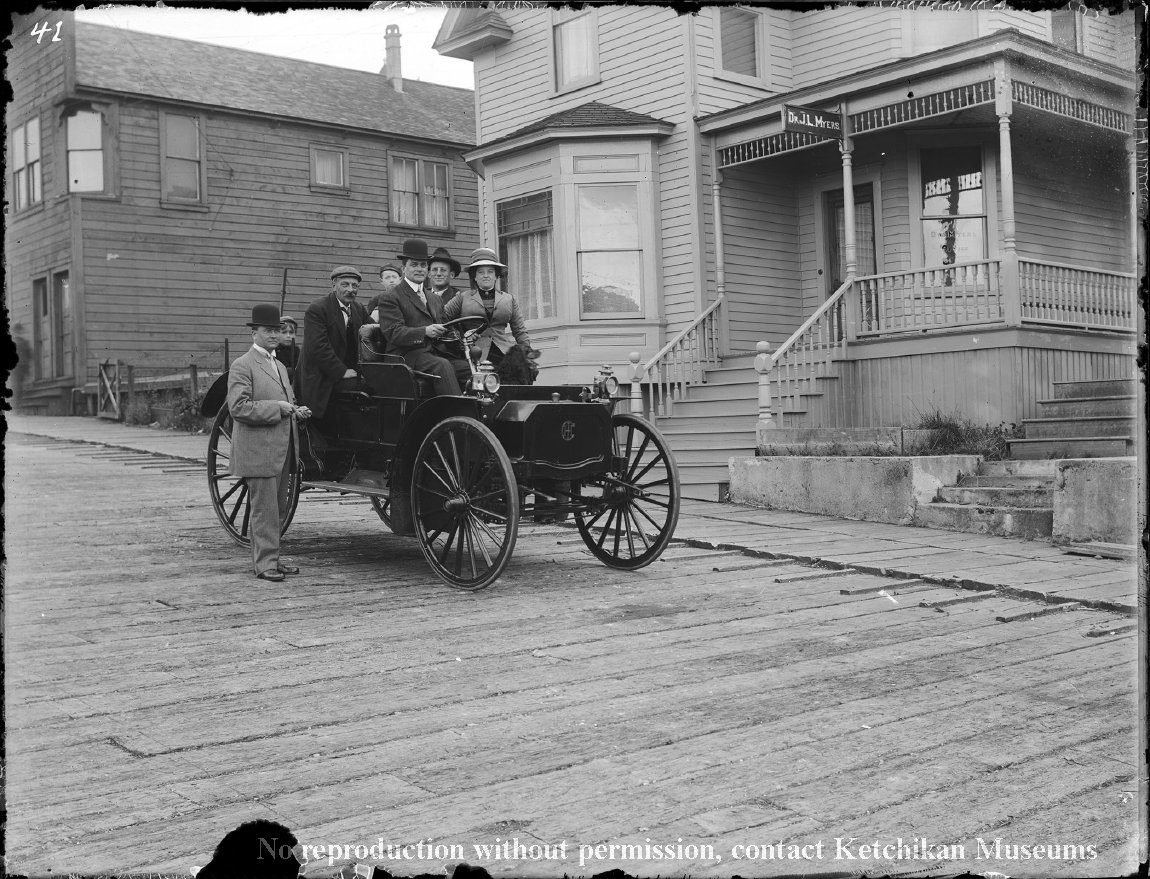 Early automobile in Ketchikan, circa 1911. Photograph by Forest J. Hunt.